Monday, February 13, 2012

Happy Valentine's Day


"The Heart Book is regarded as the oldest Danish ballad manuscript. It is a collection of 83 love ballads compiled in the beginning of the 1550’s in the circle of the Court of King Christian III. Shown above is the beginning of ballad no. 43, Store længsel, du går mig nær (Great Yearning, thou touches me)." -http://booklover.tumblr.com

Tuesday, January 24, 2012

Richard Minsky: Bindings & Embellishments

Founder of the Center For Book Arts in New York City, Richard Minsky's often elaborate sometimes shocking but always conceptually intriguing bindings push the boundaries of both book and artwork. His works explore the readability not only of the interior of literary objects but through the transformation of their exterior, cast an invocation of abstract concepts that defy containment.


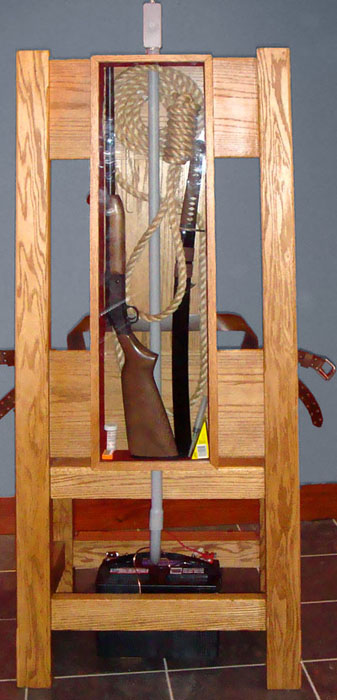
In 2009, Minsky created Freedom of Choice, a work that some would race to classify as installation rather than a fine binding. However, consider the language used by Minsky in his own discussion of the work and re-examine the work's "contents" (which would in this case be exterior to the book itself) from the perspective of a cabinet of curiosities, and the work is unmistakably a bound book. Taken from the artist's website "Copy No. 1, above, is printed inkjet on J. Barcham Green handmade paper with a 1976 watermark, bound in dark teal goatskin with 23K gold title, chained to an oak electric chair. On the inside of the head restraint are three electrodes, and one electrode goes to the leg. An MP3 player on the head restraint plays Minsky's reading of the three poems, two of which concern shotgun suicides and one an electrocution. On the back of the chair is a cabinet containing a 20 gauge shotgun, a Manila hangman's noose, a wakizashi sword, razor blades, poison and a hypodermic syringe."


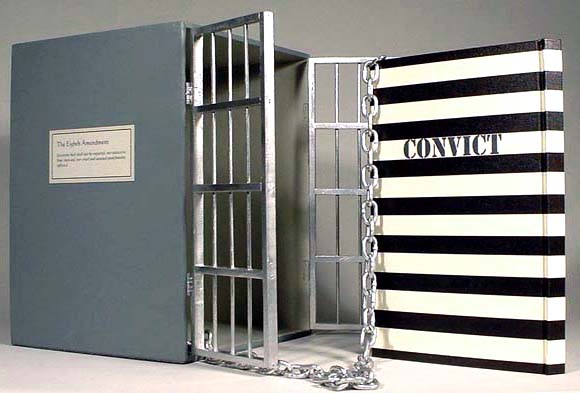
The Bill of Rights is a set of fine bindings Minsky has been working on since 1993. The books, sold and displayed as a unified collection, examine concepts as vast as freedom, war, religion, the future, the criminal justice system, and our political history while utilizing challenging, thought-provoking structures in dialogue with these concepts.


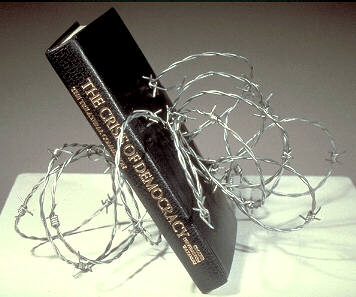
Crisis of Democracy is a transformed paperback bound in sheepskin and held upright in a barbwire stand positioned, according to the artist, in a way that reading the book, "slowly erodes the decorative surface of the skin." Here, not only is the display of the artwork taken into considering as ancilirary to the book, but it is inseparable and integral part of the book's logos.


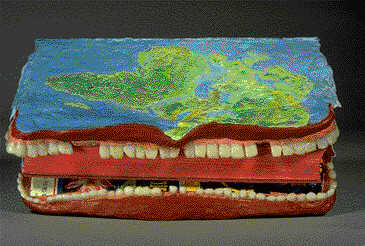
The Geography of Hunger may well be regarded as much a book sculpture as an artist's book. As the artist himself describes the piece, "The author was Chairman of the Executive Committee of the Food and Agriculture Organization. His conclusion is that the countries of the world are all capable of feeding their starving populations, but don't for political reasons. The binding is moulded and carved plastic, with a world map in acrylic paint-- the mouth of the world. The endpapers are labels from food cans bought at my local bodega, from countries where the people are starving and we get their food, and labels from Mighty Dog Gourmet Dog Food, because in this country there are old people who eat dog food and dogs who eat better than many people in the world."

Monday, January 23, 2012

Earth Inspired Works of Maggie Puckett

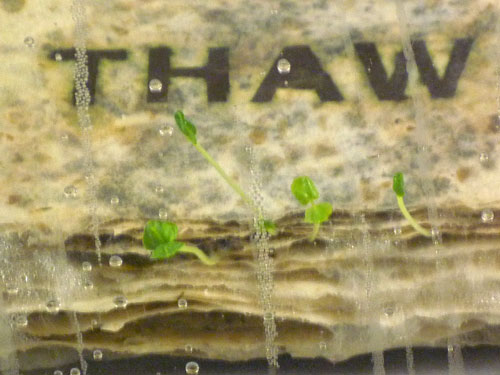
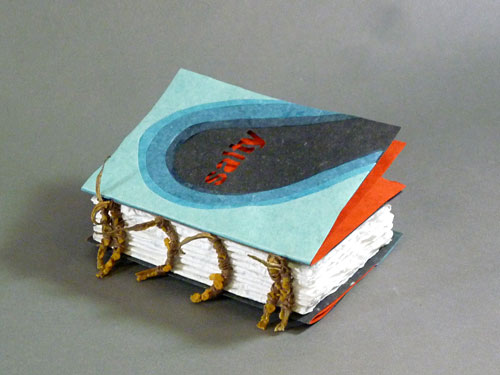
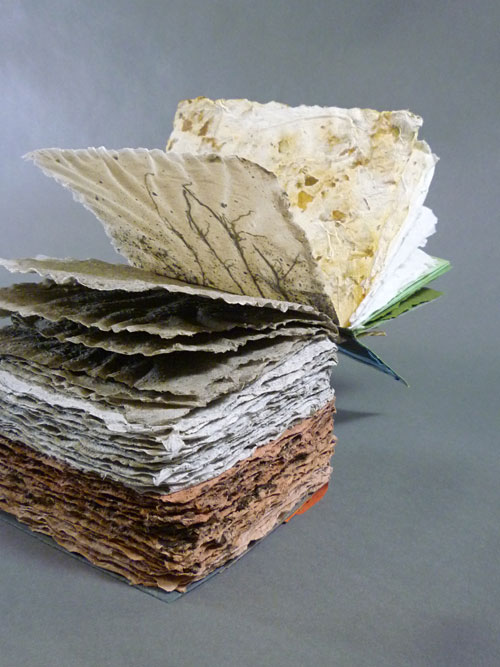
A surprising discovery are the books Thaw, Lick, and Soil Horizons, part of the ANTHROPOCENE project by Chicago-based artist Maggie Puckett. While I tend to find artists books about climate change a bit preachy and lacking in science, what is fascinating about these three books is how the process is so closely linked to their readable state, the process forming their content. They are also just beautifully crafted and very inspirational.

THAW

Thaw is a book bound, frozen and currently biodegrading. Last update during the end of Spring last year was "bugs!"

SALTY

Salty is a book that requires you to read with your tongue. The pages are made out of salt. The paper is made out of a combination of paper rag and table + sea salt.

SOIL HORIZONS

If you've ever been to a raw vegan restaurant, chances are you probably have tried raw food. Consider this a "raw book." Soil horizons is made of paper, soil, sand, roots, and leaves. Turning the pages is like digging through layers of earth. The books heft alone is impressive, and about as overwhelming as the idea of digging down to the Earth's core.

The New & The Old: Possibilities & Aesthetics of Letterpress

In researching for an upcoming project where I'll be attempting to letterpress leather, I happily stumbled upon the work of Amos Paul Kennedy, Jr., a letterpress printer based in Georgia.


The discovery of Kennedy's refreshingly voiced and graphically bold posters couldn't come at a better time. After attending the CBAA conference here at Mills and hearing Cliffton Meador's speech about how letterpress printing has overshadowed other forms of printing, particularly offset lithography, I was beginning to feel certain negative opinions of my own towards the clique of letterpress.

Although I do enjoy the aesthetics of letterpress, and love a good 8 hour print run, I do have share some of the same concerns Meador brought up in his talk. For example, take the fact that Vandercooks are utilized as the primary source of "printing technology" in nearly all college Book Arts programs, a fact Meador attributes to their availability and cost-effectiveness during the 1970s when many Book Arts programs were being formed. This focus on letterpress also at times furthers the somewhat arbitrary distinction between programs that employ various other printing techniques, discouraging collaboration between programs including: graphic design, fine art, digital printing, 3d printing, and print making. I also share Meador's disease with how many "picture books" are overlooked in the realm of artist's books, both by academics as well as curators and collectors.

Meador also touched upon aesthetic issues with letterpress. In recent years, letterpress has gathered a cult following centering around a certain kind of retrophilia that I generally find to be kitschy. This is not to say that all works produced via letterpress are inherently "old-timey" but as previously mentioned there does seem to be some confusion over how to discuss using newer technologies (and it would follow aesthetics) in combination with letterpress. As a result, it's not uncommon to find fairly simplistic graphics via polymer plates or linoleum blocks accompanying text in artist's books, where images produced via alternative modern technologies could possibly result in more dynamic graphics with a more novel aesthetic.

Again, this is certainly not true of all works produced by letterpress and there is a tradition to letterpress that I observe and respect. At the same time, I think as the art form continues to gain momentum it's important to consider new ways to use old technology as well as considering the benefits of newer technology.

In my own work, I incorporate letterpress in ways which are self-referential but experimental, aware of their unique production as well as reminiscent of their historical usage. Instances of this self-referential element occur in the books Nothing In That Drawer where the ink fades from completely saturated to a dry stamp and The Vineyard where the words of Woolf and Steel are intentionally letterpress printed to speak of the history of the production of texts (the words of Steel traditionally letterpress printed now produced in trade copies where the text is cheaply and digitally imprinted (highlighting the aura of the rare book vs. the fleeting satisfaction of the modern novel as commodity). Maybe the key word here is intention. Should an artist (of any kind) choose to use letterpress, I believe it should be for a reason and that that reason should go beyond the commercial appeal or the availability of the Vandercook.

Friday, November 18, 2011

Time, Sequence and Technology: Conference SF January 5 - 7 2012

Great news west coast book artists! The College Book Arts Association has decided to host its upcoming 2012 conference in our own backyard. This is actually great news for all of us, as it's a conference worth traveling to. Here you'll meet book artists from across the nation as well as international visiting artists. A series of brief lightning talks on this year's topic of "Time, Sequence and Technology" will see both talented students (such as yours truly) and celebrated book artihttp://www.blogger.com/img/blank.gifsts share their thoughts and inspirations. Round table discussions, divided into three groups: graduates, curators, and educators, will invite viewers to share their book-arts related questions with participants. The first day of these discussions will be hosted on Mills College campus in Oakland, CA; the second day, at The Hilton in Emeryville. Also: key note speaker Buzz Spector will allow you the opportunity to meet and get to http://www.blogger.com/img/blank.gifsee live and in the flesh Buzz Spector! For those hands-on types looking to learn something new, a series of demonstrations from Secret Belgian Binding to Cyanotype Printing will also be held in coordination with the conference. Should you want to take some new work home for yourself, the CBAA will host its first ever live auction. Lastly, but not least(ly?), a juried exhibition of members' work will be held January 5 - March 11th on the sixth floor of the San Francisco Public Library. Save the date and register here: http://www.collegebookart.org/cbaa_meetings_conferences!

Broadsides Contemporary Writers Series Mills College

The university I currently call my home away from home, Mills College, offers as part of its Book Arts program the opportunity for students to work with visiting writers on the production of a broadside (or one-sided letterpressed poster). The letterpress portion of the program under the tutelage of Kathleen Walkup also offers students the ability to work on a variety of press models to produce broadsides and limited edition print projects. They are quite lovely. Some examples below:


More here: http://www.mills.edu/academics/graduate/eng/the_scene/broadside_series.php

Monday, October 3, 2011

PRESS - San Francisco Book Art Store

Dear SF Local Book Artist,

I've been meaning to write to you about PRESS, the most adorable book art store ever to set foot on the streets of San Francisco.


PRESS, located in the Mission just shy of Dolores Park, carries a variety of book binding tools including folders, a small selection of Japanese papers, thread, and various other neat things that could be used for even neater purposes (vintage piano scrolls, anyone?) They also carry a variety of small press books, facsimiles, and vintage hard-to-find paperbacks (I picked up a Bucki Fulli that no one seems to have heard of!)


They also offer WORKSHOPS in binding, box making, and a number of other applicable, useful-to-know things for extraordinarily low costs. Their upcoming herringbone binding workshop is only $75! Not only that! Included in the class fee is a kit which has everything you'll need to get started: needles, thread, a bookbinding awl, vintage pencil and bone folder. Okay okay, so you need to bring your own ruler & scissors. Like you don't already carry that everywhere with you anyway.

I had the pleasure of meeting one of the store owners, Nick Sarno, who I can vouch is a dedicated book lover and a really nice guy. Go in! Say hi!